Define the return before counting it
The deck distinguishes financial yield, or profit for a business; economic yield, including local value and employment; and sustainable yield, which also accounts for social and environmental effects. These are different measures, and they can move in different directions. Presentation, slide 8 ↗ Source
What the visitor contributes to revenue and profitability.
What local workers and businesses receive, net of leakage elsewhere.
How the activity affects people, culture and the environment over time.
A high nightly rate by itself says little about how much stays in a community. Equally, a modestly priced visit may buy local meals, guides and crafts. The point is not to assign moral value to a price category. It is to test the full return against the costs. This is the argument of the presentation, not a measured result for Salalah.
High-yield is not a synonym for luxury
The slides describe a traveler interested in immersive experiences, meaningful connections and conscious choices. They contrast that profile with luxury defined by exclusivity and with mass tourism defined by volume. These are useful planning distinctions, not fixed or mutually exclusive groups: someone can travel luxuriously and still buy locally, or travel on a budget and contribute deeply. Presentation, slides 15–16 and 26–28 ↗
Spending more does not automatically reduce a trip’s footprint. It matters where money goes, how long visitors stay, and how much resource use each visit requires. The deck proposes that destinations balance revenue with community benefit and environmental pressure, rather than assuming that fewer, wealthier guests will solve either problem. Source
For tourism businesses this can mean experiences made with local operators, procurement that retains income in the destination, and offers built around specific interests rather than a broad campaign to everyone. The presentation names gastronomy, cycling, wildlife and cultural immersion as possible niches. Presentation, slides 53–56 ↗
Three ways to make a niche tangible
The presentation names three travel companies as illustrations of specialized experiences. Their sites show the types of offers; the slides do not establish that any one operator achieves higher local retention or a lower environmental impact. Those outcomes would need separate evidence. Presentation, slide 56 ↗
- 01Expedition travel.
National Geographic Expeditions ↗ uses specialist-led journeys as an example of travel organized around learning and place.
- 02Cycling journeys.
Butterfield & Robinson ↗ offers cycling trips, showing how one interest can shape the route, pace and local encounters.
- 03Safari travel.
Abercrombie & Kent ↗ offers wildlife journeys built around a specific reason to travel.
For Oman, these are prompts rather than templates. A destination should start with its own people, places and operating constraints before deciding which interest-based offers to develop.
Measure what remains in the destination
Slide 50 proposes replacing a single focus on arrivals and room rates with a wider set of indicators. For destinations: spending on locally made products, income that leaks away, local jobs, repeat visits and resident sentiment. For hotels: local sourcing, water and energy use, guest participation in local activities and guest feedback. These are suggested measures, not reported figures for the conference or Oman. Presentation, slide 50 ↗
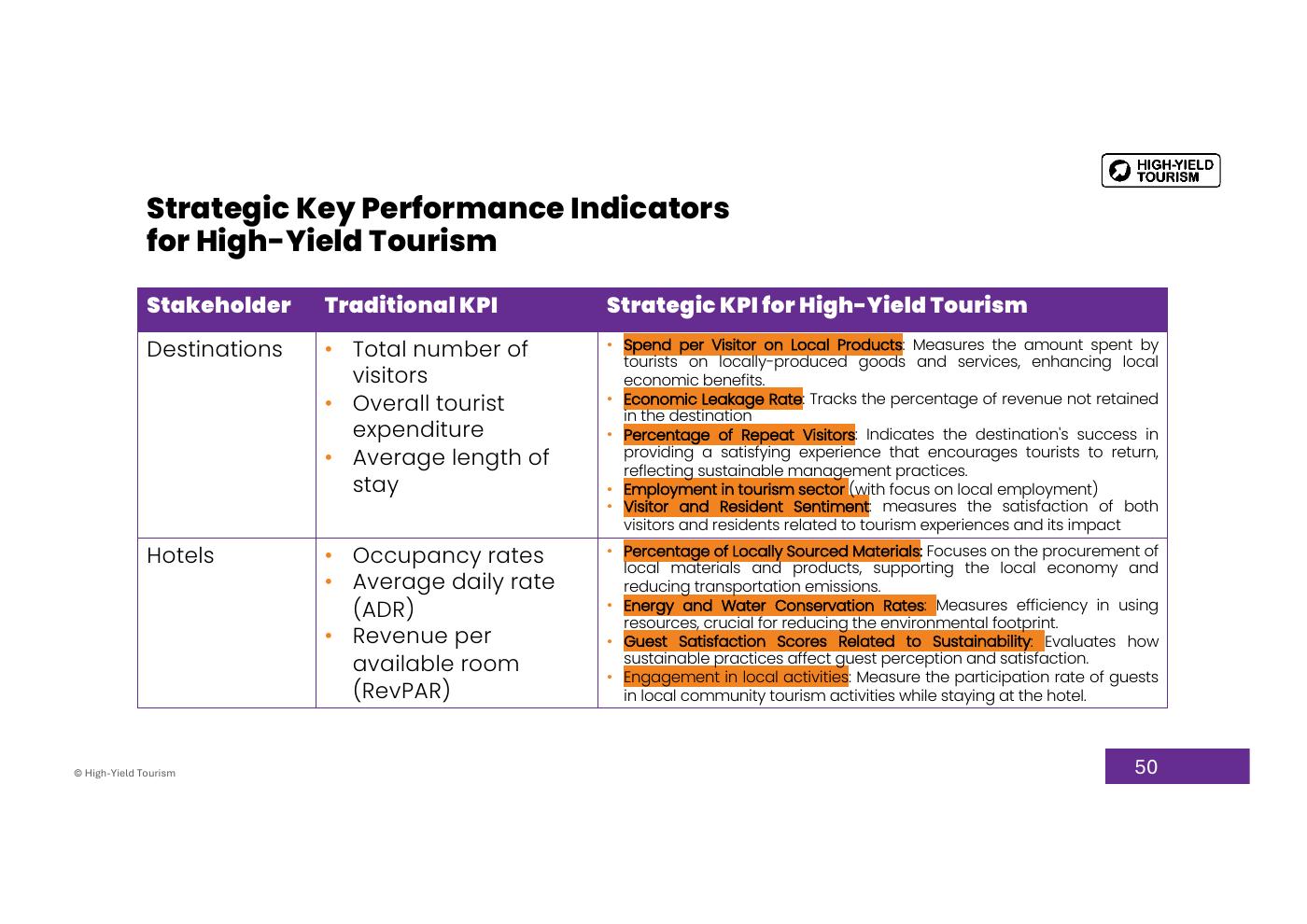 PROPOSED DESTINATION AND HOTEL MEASURES · FROM THE PRESENTATION
These measures make the argument falsifiable. If an offer raises receipts but reduces local procurement or strains water supplies, the destination can see the trade-off. If it grows local employment and resident support, it has evidence of a broader return. The next step is to collect a baseline, then compare outcomes over time, rather than treating high-yield as a label for a more expensive trip.