
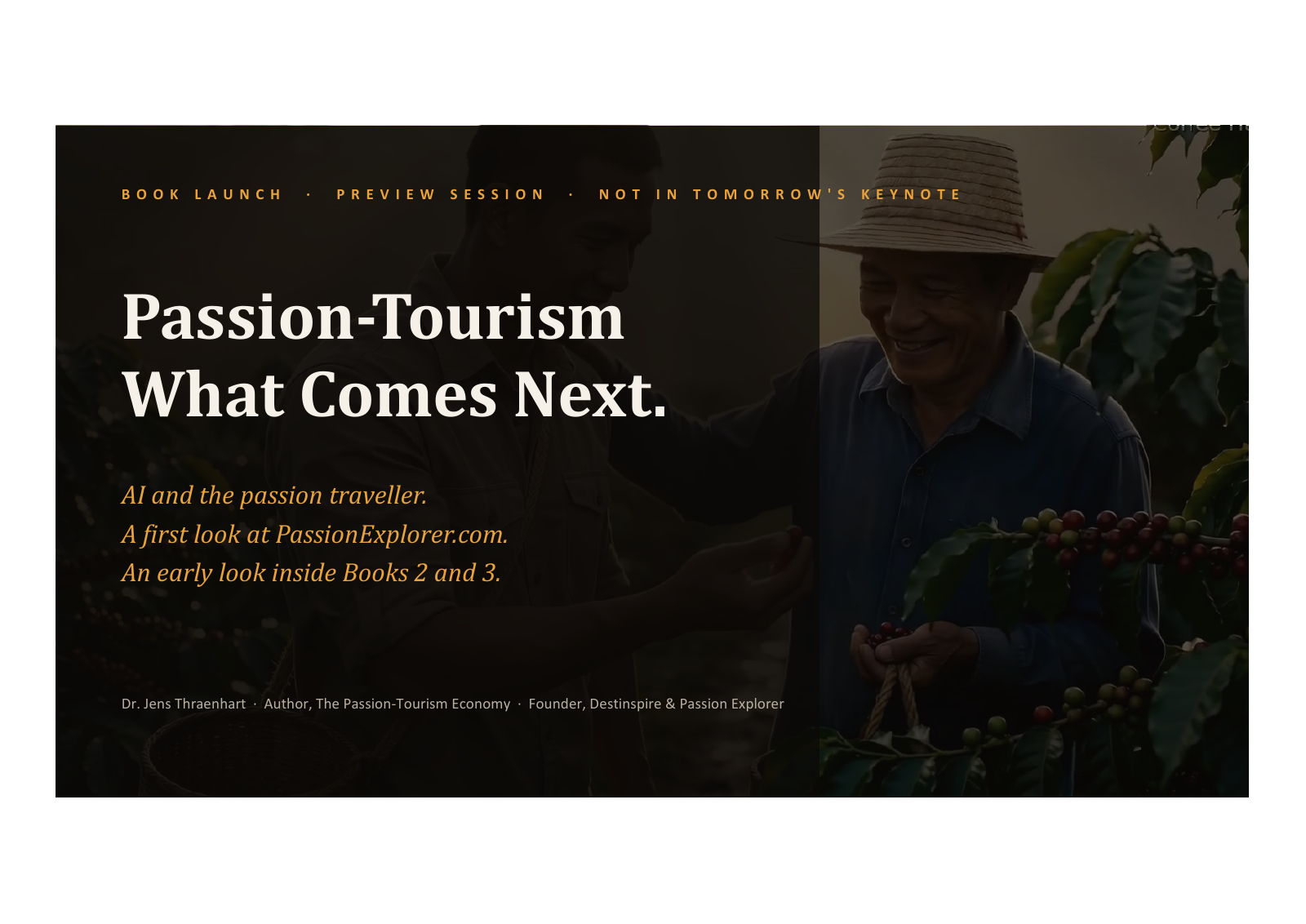
This briefing follows the supplied 25-page preview-session presentation. Product features, book plans and the proposed verification partnership are presented as Jens’s announcements, not independently audited results or promises of availability.
Be found by an assistant, not only a search engine
Marriott Bonvoy’s Ticket to Travel 2026 research reports that 50% of respondents had used AI to plan or research a holiday, compared with 41% and 26% in the two preceding editions. The October 2025 release describes research among more than 22,000 adults in 11 Europe, Middle East and Africa markets. This is brand-sponsored survey evidence, not a global measure of all travellers or a 2026 fieldwork result.
The presentation asks what happens when a traveller’s assistant reads a destination website on their behalf. A place with a strong tradition can still be absent from the answer if reliable information about it is difficult to find or interpret. The slide about Spanish castles is an illustration from the talk, not a reproducible benchmark of all AI systems.
Publish clear information about named practitioners, the experience they offer, suitable seasons, access and capacity. Check that an assistant can find the correct source and that its answer matches what a visitor can actually book. Visibility is not a substitute for accuracy. Source Source
Give AI a defined job
The deck proposes five tasks: find interest communities in forums and searches; map lesser-known experiences; publish information machines can read; plan journeys around a passion; and look for early changes in demand. These are proposed uses, not evidence that an algorithm has increased local income.
AI can draft a village or experience page, but a knowledgeable person needs to check every line. A trip plan must respect real opening times, access, host availability and travel distances. Signals from search or conversation are reasons to investigate demand, not confirmed bookings. Source
Never invent a Keeper
The three guardrails are explicit: never invent a Keeper, never speak for a community without consent, and never send more visitors than a place can carry. A Keeper is the person who holds the practice or knowledge. They must be real, reachable and willing to take part.
Keepers decide what is shown and what stays private. Capacity comes from the host and the site, not an itinerary generator. Consent, prices and limits should remain visible and correctable as information is reused across pages and assistants. Source
Start with the passion, then find the place
Passion Explorer is introduced as a way to discover travel through an interest rather than a country list. The Thailand Explorer demonstration offers two starting points: choose a passion and see where it lives, or choose a destination and see its passions. The intended result is a day-by-day plan.
The supplied slides describe 20 passions across 11 Thai destinations at the time of the preview. That is an author-reported snapshot of the demonstration, not a verified current inventory. The films and narrated demos below show the supplied product material; current features should be checked on the product sites.
Destination and Hotel Editions are presented as private-label directions: destination-specific content and trip planning for tourism boards, and experiences around properties for hotel groups. First-party data ownership and full practitioner payment are design commitments in the presentation, not independently verified operating results. Source Source
Discovery stays open. Promotion is earned.
The deck announces a planned partnership between Passion Explorer and the Good Travel Institute to connect passion-led discovery with independent sustainability verification. It states that both partners are committed, while the pilot and verification criteria remain to be announced. This page does not present a live certification programme or a list of approved experiences.
The proposal uses the Passion Triangle: an Authority sets the quality bar for the passion; the Keeper gives consent, sets limits and is paid first; the Host runs the trip and is the party to be certified. The intended benefit is to make verification visible where travellers choose, without charging Keepers to participate.
Diagnose. Build. Protect.
Book 1, The Devotion Dividend, asks which communities care enough about a passion to shape their travel. The preview introduces Book 2, The Depth Advantage, planned for 2027, as the build manual: partners, investment, measurement, machine-readable destinations and what to refuse.
Book 3, The Authenticity Trap, planned for 2028, asks what success can damage: copied labels, scarce Keepers, sold assets and scores that can be gamed. Its proposed focus is prevention, repair and the protection of the practice that made a destination worth visiting.
The Passion Purpose Index is the proposed thread through the three books: diagnose the destination, review it while building, and watch for decline. It is Jens’s framework, not an independently validated standard. The book dates and contents are publishing plans from this preview and may change. Source Source
Bring the question back to local benefit
The closing slides connect the Passion-Tourism Atlas and industry voices with a movement from volume to value. The “88 voices” figure is a snapshot reported by the presentation, not a current count or proof that all destinations have adopted the approach.
For a destination or hotel, the test remains practical: does discovery lead to an experience that is honestly represented, wanted by its hosts and worth delivering? Follow the payments to practitioners, listen to residents and review pressure on the place before treating additional attention as success. Source Source